Kundali Matching
Marriage compatibility by date of birth
Check marriage compatibility based on the traditional 36 Guna system of Vedic Astrology.

Check marriage compatibility based on the traditional 36 Guna system of Vedic Astrology.
Kundali matching (Kundli Milan) is the Vedic astrology practice of comparing two birth charts before marriage to assess compatibility. It uses the Ashtakoot (36 Guna) system, which scores 8 factors — Varna, Vashya, Tara, Yoni, Graha Maitri, Gana, Bhakoot and Nadi — each with a maximum point value, for a total of 36 points. A score of 18 or above is generally considered acceptable for marriage; scores above 30 indicate an excellent match. The Moon sign and Nakshatra of both partners are the primary inputs, so an accurate birth date, time and place are essential.
Kundli matching compares the birth charts (horoscopes) of two individuals before marriage. It studies planetary positions, Moon signs, Nakshatras, and doshas to determine compatibility.
Looking for accurate marriage compatibility by date of birth? Before proceeding, many families first check auspicious Marriage dates to ensure the wedding is aligned with favorable planetary timings.
Our advanced Kundli Match for Marriage Calculator helps you check your relationship harmony using authentic Vedic astrology principles. It is traditionally done using the powerful Ashtakoot matching system, which evaluates 8 key compatibility factors and gives a score out of 36.
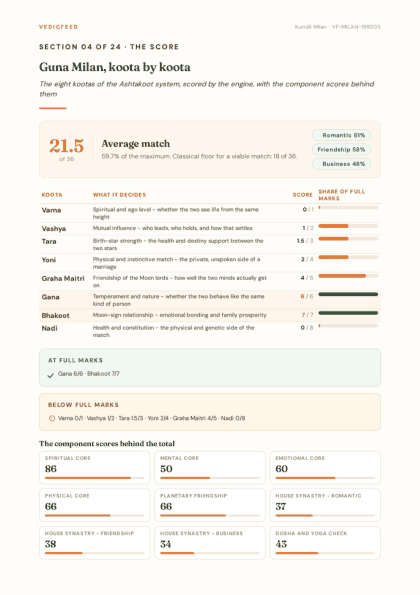
The total score from these 8 Kootas forms the astrology compatibility score.
However, expert astrologers always recommend a deeper chart comparison beyond Guna Milan. For couples planning engagement or wedding rituals, checking the day's choghadiya and consulting a detailed Panchang ensures the ceremony aligns with auspicious planetary hours.
The Ashtakoot matching system evaluates 8 categories (Kootas):
| Koota | Factor | Maximum Points | What It Represents |
|---|---|---|---|
| Varna | Spiritual compatibility | 1 | Ego & spiritual level |
| Vashya | Mutual attraction | 2 | Control & influence |
| Tara | Birth star harmony | 3 | Health & destiny |
| Yoni | Sexual compatibility | 4 | Physical chemistry |
| Graha Maitri | Planetary friendship | 5 | Mental compatibility |
| Gana | Temperament match | 6 | Nature & behavior |
| Bhakoot | Emotional bonding | 7 | Family prosperity |
| Nadi | Health & genetics | 8 | Progeny & health |
| Total | 36 Points | ||
This structured scoring method is called the Vedic astrology guna table calculation method.
Beyond Guna Milan, our system also evaluates:
This is called a Vedic synastry chart, offering deeper insight than basic kundali matching.
One important factor in a kundli match for marriage is Mangal Dosha. If Mars is placed in certain houses (1st, 4th, 7th, 8th, 12th), it can create delay or conflict in marriage. However, modern astrology also considers cancellation rules (Mangal Dosha cancellation).
Marriage success depends largely on:
A strong emotional connection ensures long-term harmony beyond physical attraction.
Vedic astrology is deeply mathematical. Each Nakshatra and Moon sign represents a specific vibrational frequency. When two frequencies align, harmony increases. When they clash, friction occurs.
"Marriage compatibility by date of birth is based on cosmic mathematics — not superstition."
In traditional Indian families, kundli matching is considered essential before marriage decisions.
Not true. Even a 20-point match can work if planetary positions are strong.
Even love marriages benefit from compatibility analysis.
Not necessarily. Remedies and deeper analysis matter greatly.
Even love marriages benefit from compatibility checks.
Kundli matching is preventive guidance, not fear-based astrology.
A combination of:
Gives the most reliable result.
If you are considering marriage, checking your Kundali matching by date of birth only is a wise first step — but always complement it with detailed horoscope analysis.
Marriage is a lifelong journey. When cosmic energies align, harmony flows naturally.
This free tool is built and maintained by the VedicFeed team, a Vedic astrology resource publishing daily panchang, muhurat dates and compatibility tools since 2018. The 36-Guna Ashtakoot calculation follows traditional Vedic texts and runs entirely in your browser — no personal data is stored or transmitted beyond the birth details needed for the calculation.
Last updated: August 2026 · About VedicFeed · Contact
Yes, if planetary alignment supports the relationship. A full horoscope analysis can reveal strengths not captured by Guna Milan alone.
Absolutely. Even small time errors can change Nakshatra and the resulting compatibility score significantly.
Full chart matching (Vedic synastry chart) gives better accuracy. Guna Milan is a helpful starting point but not the only factor to consider.
Yes, 18 is the minimum acceptable score, but deeper horoscope analysis is recommended for a complete and reliable assessment.
Kundali matching is calculated by comparing the Moon Nakshatras of both partners. Each partner's birth details (date, time, place) are used to find their Nakshatra and Moon sign, then the Ashtakoot system scores 8 factors — Varna, Vashya, Tara, Yoni, Graha Maitri, Gana, Bhakoot and Nadi — adding up to a maximum of 36 Guna points.
The highest possible score in Ashtakoot kundli matching is 36 out of 36 Guna points. A score of 31–36 is considered an excellent match, 25–30 is good, 18–24 is average, and below 18 is not recommended.
If the Ashtakoot score is low, it does not automatically mean the marriage will fail. Astrologers consider cancellation rules (like Mangal Dosha cancellation), check the full birth charts for supporting factors, and may suggest remedies such as puja, mantra or specific gemstones. Many couples with scores below 18 still have successful marriages when the full chart is harmonious.
The Ashtakoot Guna Milan system described on this page follows classical Vedic astrology texts, including the Brihat Samhita (Varahamihira) and the Muhurta Chintamani, which codify the 8 Kootas and their point allocations. The 36-Guna framework and Nadi/Bhakoot dosha rules are the standard method taught in traditional Jyotish (Vedic astrology) schools in India.
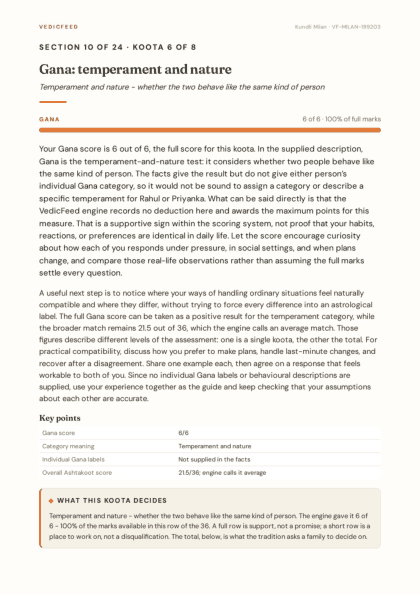
Every koota explained koota by koota, Mangal and Nadi dosha on both charts, marriage timing for both of you, and the remedies the tradition prescribes - built from the same birth details you just entered.
Real pages from the report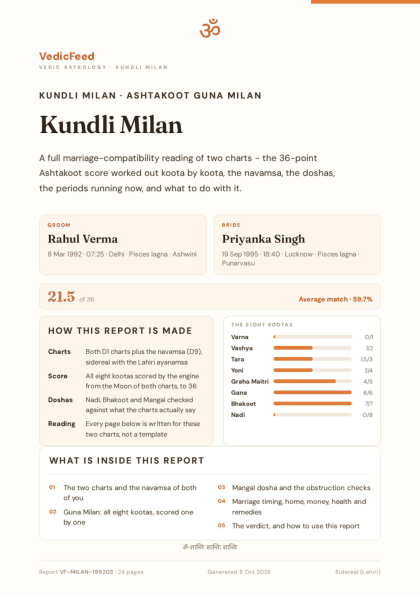
Only here for a question? Ask the AI astrologer