
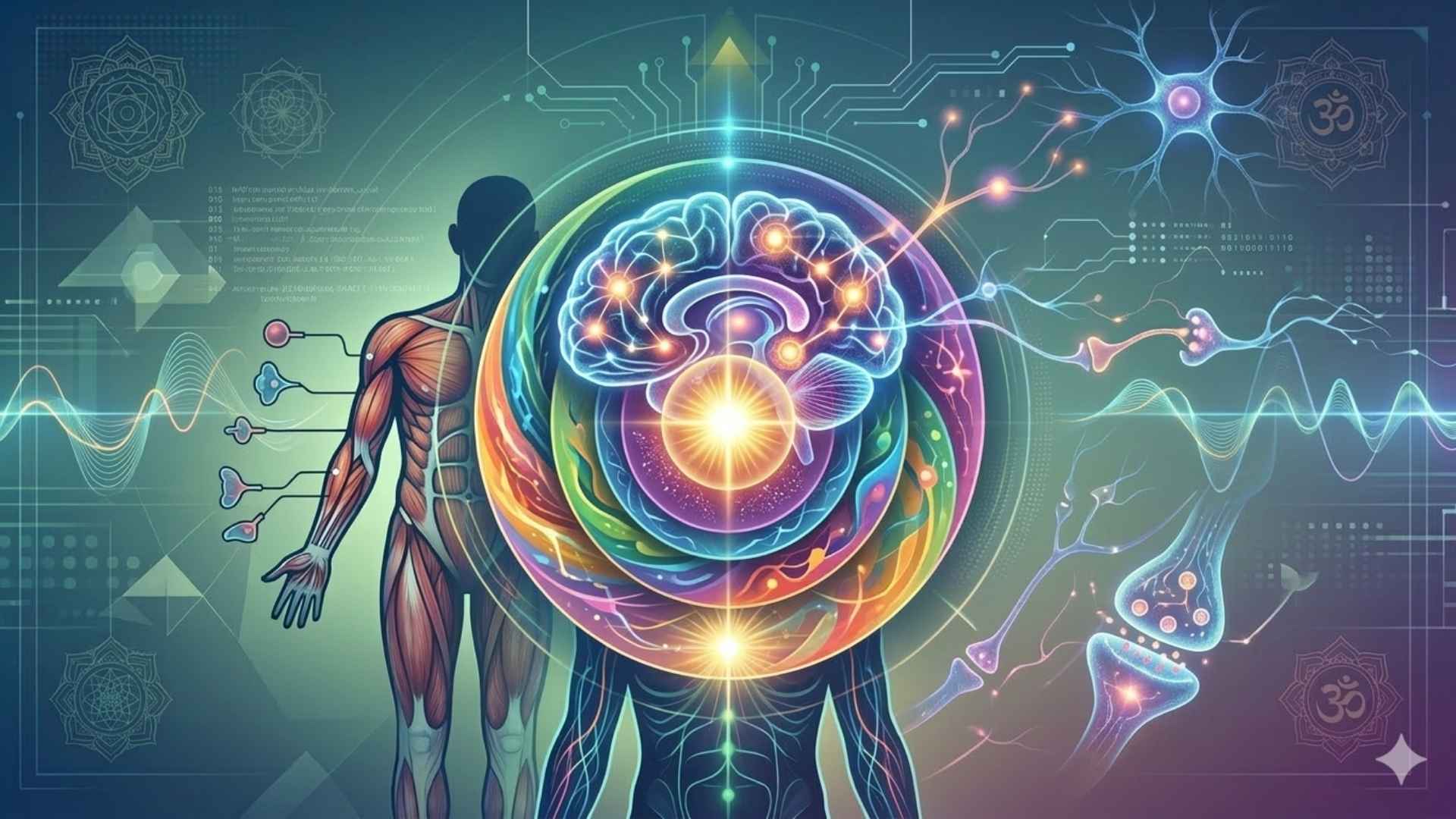
The human mind has fascinated thinkers for thousands of years. Ancient Vedantic sages mapped the self through five distinct layers called the Pancha Kosha. Modern neuroscientists map it through neurons, brain regions, and cognitive systems. Both traditions arrive at a surprisingly similar picture of human awareness.
The Pancha Kosha, or five sheaths, describes the self as layered. Each layer moves from gross physical matter to subtle pure consciousness. Neuroscience, working from the outside in, has identified parallel systems independently. This article traces those connections layer by layer.
The First Sheath: Annamaya Kosha and the Physical Brain
Annamaya Kosha is the physical body, the outermost layer of the self. It includes bones, muscles, organs, and the entire nervous system. Neuroscience studies this layer through the sensorimotor cortex and the body schema. The body schema is a real-time map of the physical self in space.
The Global Neuronal Workspace Theory places consciousness inside this physical layer. It suggests that complex neuronal computations give rise to awareness. Brain scans using fMRI confirm that specific physical regions activate during conscious experience. The physical body is, by this view, the foundation of all mental life.
The Second Sheath: Pranamaya Kosha and the Autonomic Nervous System
Pranamaya Kosha governs the life force, or Prana, that animates the body. It regulates breathing, circulation, and all key physiological processes. Modern science identifies this function within the Autonomic Nervous System (ANS). The ANS controls the body’s involuntary systems, from heart rate to digestion.
Research on Heart Rate Variability (HRV) offers a direct scientific window into this sheath. Higher vagal tone reflects a well-regulated Pranamaya Kosha. Studies on Pranayama, or yogic breathwork, show measurable changes in parasympathetic activity. Regulating the breath directly shifts the body’s physiological state.
The Third Sheath: Manomaya Kosha and the Limbic System
Manomaya Kosha is the mental and emotional layer of the self. It processes sensory input, generates emotional responses, and stores habitual patterns. Neuroscience maps this layer to the limbic system, including the amygdala and hippocampus. These structures govern fear, memory, attachment, and emotional tone.
Affective neuroscience studies how emotions arise from specific neural circuits. This sheath sits as a link between instinct and higher thought. Many people identify strongly with this layer, treating feelings as fixed truths. Practices like meditation and Karma Yoga help loosen that identification.
The Fourth Sheath: Vijnanamaya Kosha and the Prefrontal Cortex
Vijnanamaya Kosha represents higher intellect, discernment, and intuitive wisdom. It is the layer that watches the mind without reacting to it. The prefrontal cortex carries out similar executive functions in the brain. It governs planning, decision-making, and metacognitive awareness.
Integrated Information Theory (IIT) offers a neuroscientific parallel to this sheath. IIT proposes that consciousness grows as more information gets processed together. The prefrontal cortex is the brain’s primary seat of this processing capacity. Self-inquiry practices like Atma-Vichara actively develop this kind of awareness.
The Fifth Sheath: Anandamaya Kosha and the Default Mode Network
Anandamaya Kosha is the subtlest of the five layers. It corresponds to deep states of joy, stillness, and non-dual awareness. Neuroscience connects these states to the Default Mode Network (DMN). The DMN is a set of brain regions active during self-referential thought and daydreaming.
During deep meditation, the DMN shows reduced activity. Simultaneously, researchers observe heightened gamma wave activity in experienced meditators. These neurological signatures appear in states that Vedanta calls Samadhi. The brain, at its most quiet, reflects the Vedantic description of pure bliss.
The Hard Problem and the Limits of Materialist Neuroscience
Neuroscience has mapped the Neural Correlates of Consciousness (NCC) with growing precision. It can identify which brain regions activate during specific experiences. What it cannot fully explain is why any physical process produces subjective experience. Philosophers call this the “Hard Problem of Consciousness.”
Vedanta addresses this gap directly. It does not treat consciousness as a product of the brain. Pure Consciousness, or Chaitanya, is considered the fundamental reality. All five sheaths arise within consciousness as expressions of it.
Panpsychism, Materialism, and the Vedantic View
Mainstream neuroscience tends toward a materialist position. It views the mind as a product of physical brain processes. Panpsychism offers a different view, one where consciousness is a basic property of reality. The Vedantic model sits closer to panpsychism in its core assumptions.
Ken Wilber’s Integral Theory (AQAL model) attempts to bridge these positions. It maps human experience across individual, collective, interior, and exterior dimensions. The Pancha Kosha fits naturally within this framework. Ancient Vedantic thinkers had, in effect, constructed an early integral model of the self.
Practical Implications for Health and Self-Knowledge
Understanding the Pancha Kosha through a neuroscientific lens has real practical value. Each sheath points to a specific area of health, from physical fitness to emotional regulation. Practices targeting each layer produce measurable physiological and cognitive changes. Research in contemplative neuroscience supports these findings.
Asana and diet support the Annamaya Kosha and the brain’s physical health. Pranayama regulates the ANS and strengthens vagal tone. Meditation and Karma Yoga quiet the limbic system and loosen habitual emotional patterns. Self-inquiry and scriptural study activate the prefrontal cortex and deepen metacognitive clarity.
The Path Toward Self-Realization
The Vedantic method for moving through the sheaths is called Neti-Neti, meaning “not this, not this.” The practitioner examines each layer and recognizes it as an object of awareness. The one who is aware cannot itself be an object. This process of disidentification continues until only pure awareness remains.
Each sheath requires a specific practice to loosen its grip. The body needs disciplined care through asana and proper diet. The energy and mind sheaths respond to Pranayama, sensory withdrawal, and selfless service. The intellect and bliss layers require self-inquiry and the deep stillness of Samadhi.
A Unified Picture of Human Awareness
The Pancha Kosha offers a layered map of the self, developed over millennia of Vedantic study. Modern neuroscience has arrived at compatible findings through its study of the brain, the ANS, the limbic system, and the prefrontal cortex. Each sheath corresponds to a real neurobiological system and responds to specific practices, from asana to Samadhi. Together, these two traditions point toward a fuller understanding of human awareness, grounded in both science and direct experience.