
Navaratri Day 9 is dedicated to Maa Siddhidatri, the ninth manifestation of Maa Durga. On this day, devotees worship the goddess to seek her blessings for success, wealth, and prosperity. Maa Siddhidatri is known as the granter of boons and is believed to have immense powers to bless her devotees with supernatural gifts.
In 2026, Navratri Day 9 falls on Monday, 19 October 2026, which is Maha Navami, when Maa Siddhidatri is worshipped on Ashwina Shukla Navami. Sharad Navratri 2026 begins on Sunday, 11 October 2026 with Ghatasthapana, and Vijayadashami or Dussehra follows on Tuesday, 20 October 2026.
- Navratri Day 9 / Maha Navami 2026: Monday, 19 October 2026
- Tithi: Ashwina Shukla Navami (Sharad Navratri)
- Goddess: Maa Siddhidatri, the ninth and final form of Navadurga
- Mantra: Siddh Gandharv Yagyadhair Surair Marairapi, Sevyamana Sada Bhooyaat Siddhida Siddhi Dayanee – the Siddhidatri mantra given on this page
- Colour of the day in 2026: Peacock Green in the colour list published by Prokerala – the nine-day colour list is set fresh each year and differs between panchangs
- Navratri 2026 begins (Ghatasthapana): Sunday, 11 October 2026
- Navami tithi: in 2026 it runs from the morning of 19 October to around midday on 20 October; exact clock times vary by source and place
- Vijayadashami / Dussehra (Day 10): Tuesday, 20 October 2026
The ninth day is fixed by the tithi, not by a calendar date: Siddhidatri puja and Maha Navami are observed while Ashwina Shukla Navami is current, which is why the day shifts each year. In 2026 it falls on 19 October, and it is also the day on which the nine nights of Durga worship are completed. Because a tithi is counted from local sunrise, the puja window for the ninth day differs from city to city, so follow a panchang for your own location rather than copying another city’s clock time.
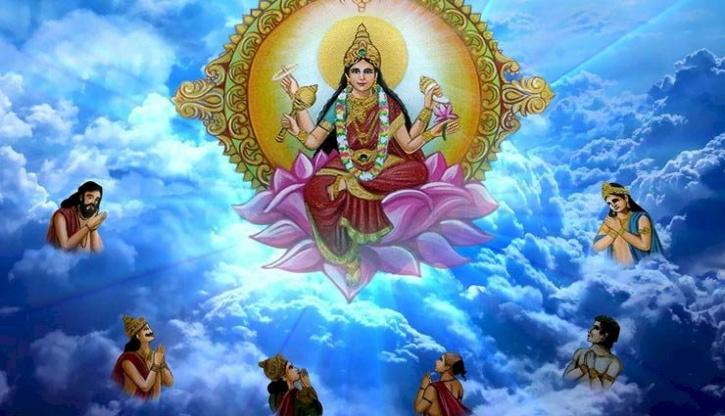
Worshiped on the ninth day, Goddess Siddhidhatri is projected as a four-armed deity sitting calmly on a lotus. Siddhidatri is the final form of Durga, celebrated on the final night of Navaratri. Siddhidatri grants wisdom and insight to those who appeal to her.
Like some of Durga’s other manifestations, Siddhidatri rides a lion. She has four limbs and carries a trident, a spinning disc called a Sudarshana Chakra, a conch shell, and a lotus. The conch, called a Shankha, represents longevity, while the spinning disc symbolizes the soul or timelessness.
It is believed that Goddess Siddhidatri provides direction and energy to planet Ketu. Hence planet Ketu is governed by her.

Origin of Siddhidatri Devi
It is believed that one side of Lord Shiva’s body is that of Goddess Siddhidatri. Therefore, he is also known by the name of Ardhanarishwar. According to Vedic scriptures, Lord Shiva attained all the siddhis by worshiping this Goddess.
According to Hindu Shastras like Markand Puranas, this Goddess helps devotees attain perfection in Mahima, Garima, Ladhima, Prapti, Prakaamya, Ishitva, and Vashitva. According to Brahmavaivart Purana, the Devi can bestow 18 types of siddhis or perfection.
These siddhis are Mahima, Garima, Ladhima, Prapti, Prakaamya, Ishitva and Vashitva sarvakaamaal, Saadhita, Sarvagynatva, Amaratva, Sarvanyayakatva, Bhavana and Siddhi. Worshiping Maa Siddhidatri wholeheartedly heart helps devotees attain perfection along with happiness and purity.
When the Universal Mother was gripped with the idea of projecting Creation, She, first of all, created Lord Shiva, who prayed to Her to endow him with perfection. For this purpose, the Universal Mother (Durga) created Goddess Siddhidaatri. Goddess Siddidaatri bestowed eighteen kinds of rare perfection and powers and potentialities (Siddhis) on Lord Shiva at the behest of the Universal Mother. By these siddhis, Lord Shiva happened to develop a divine splendor.
Having acquired the siddhis from Goddess Siddhidaatri, Lord Shiva created Lord Vishnu, who created Lord Brahma, who was entrusted with the task of Creation, whereas Lord Vishnu got the task of Protection and Lord Shiva that of Destruction.
Lord Brahma felt great difficulty in his task of creation in the absence of man and woman. Thereupon he remembered Mother Siddhidaatri. Lord Brahma said to her when she appeared before him, “Oh Great Mother! I cannot carry on with the task of the Creation in the absence of man and woman. You kindly solve my problem through your supernatural attainments (siddhis).”
Having heard Lord Brahma, Mother Siddidaatri converted half the person of Lord Shiva into a woman. Thus Lord Shiva became half-male and half-female and became known as Ardhanaarishwara. Thus the problem of Lord Brahma was resolved, and the task of the Creation went on smoothly.
Maa Siddhidatri Puja Vidhi
The Puja Vidhi of Maa Siddhidatri usually involves the following steps:
- Ganesha Puja: Devotees begin by offering prayers to Lord Ganesha to seek his blessings for a successful Puja.
- Kalash Puja: A Kalash or a pot filled with water is placed on a heap of rice, symbolizing abundance and prosperity. The Kalash represents Maa Siddhidatri, and devotees offer prayers to it for blessings.
- Invocation: The goddess is invoked with the chanting of mantras, and various offerings such as flowers, fruits, coconut, and sweets are offered.
- Nine Forms of Durga: As Navaratri Day 9 signifies the manifestation of Maa Siddhidatri, it is essential to offer prayers to the nine forms of Durga. Each form of Durga is worshipped with appropriate mantras, bhajans, and offerings.
- Aarti: The Puja concludes with the Aarti, or the offering of light, which symbolizes the removal of darkness and the attainment of enlightenment.

Bhogs to Offer Maa Siddhidatri
Bhogs are offerings made to the deities during the Navaratri Puja. On Navaratri Day 9, which is dedicated to Maa Siddhidatri, devotees offer various bhogs to seek her blessings. Here are some popular bhogs that devotees can offer:
- Sweets: Maa Siddhidatri is particularly fond of sweets, and devotees can offer her laddoos, pedas, and other sweets made of milk, sugar, and flour.
- Fruits: Offering fruits is considered auspicious during the Navaratri Puja. Devotees can offer fruits like bananas, apples, and oranges as a bhog to Maa Siddhidatri.
- Coconut: Coconut is another popular bhog that devotees offer during the Puja. The coconut is considered to be a symbol of the human soul, and offering it to the deity shows respect and devotion.
- Flowers: Flowers are a must-have during the Puja, and devotees can offer a variety of flowers like marigold, jasmine, and roses to the goddess.
- Kheer: Kheer, or rice pudding, is considered to be a significant prasad that is offered to Maa Siddhidatri on Navaratri Day 9. It is a sweet dish made of rice, milk, sugar, and cardamom, which is cooked and offered as a bhog to the goddess.
Offering bhogs to Maa Siddhidatri on Navaratri Day 9 is a way to seek her blessings for success, wealth, and prosperity. Devotees can offer a variety of sweets, fruits, coconut, flowers, and kheer as bhogs to the goddess. Offering bhogs with devotion and sincerity can bring immense blessings from the deity, and make the Navaratri Puja even more sacred and fruitful.
Siddhidatri Mantra
सिद्धगन्धर्वयक्षाद्यैरसुरैरमरैरपि
सेव्यमाना सदा भूयात् सिद्धिदा सिद्धिदायिनी ॥Siddh Gandharv Yagyadhair Surair Marairapi
Sevyamana Sada Bhooyaat Siddhida Siddhi Dayanee.
Meaning: “The ways in which all the gods, Goddess and divine souls worship you, in the same manner, we worship you. Kindly grant your blessings to us.”
Navaratri Day 9 is an auspicious day to seek blessings from Maa Siddhidatri and attain success, wealth, and prosperity. The goddess is known for her divine powers and ability to grant her devotees with supernatural gifts. Therefore, devote some time this Navratri to worship Maa Siddhidatri using the Puja Vidhi and mantras and seek her blessings for a happy and prosperous life. May the goddess bless you with immense wealth and prosperity!
Frequently Asked Questions
When is Navratri Day 9 in 2026?
Navratri Day 9, dedicated to Maa Siddhidatri, falls on Monday, 19 October 2026, on Ashwina Shukla Navami during Sharad Navratri.
Is Navratri Day 9 the same as Maha Navami?
Yes. The ninth day of Sharad Navratri is Maha Navami, and Maa Siddhidatri is the Navadurga form worshipped on it. In 2026 both fall on Monday, 19 October 2026.
Which goddess is worshipped on the ninth day of Navratri?
Maa Siddhidatri, the ninth and final of the nine Navadurga forms of Goddess Durga. She is worshipped on Ashwina Shukla Navami, the last of the nine nights.
What is the mantra for Navratri Day 9?
The Siddhidatri mantra given on this page is Siddh Gandharv Yagyadhair Surair Marairapi, Sevyamana Sada Bhooyaat Siddhida Siddhi Dayanee, which devotees repeat 108 times.
When does Sharad Navratri 2026 begin and end?
Sharad Navratri 2026 begins with Ghatasthapana on Sunday, 11 October 2026 and the nine nights run to Maha Navami on Monday, 19 October 2026, with Vijayadashami on Tuesday, 20 October 2026.
Why is Navratri Day 9 on a different date every year?
Day 9 follows Ashwina Shukla Navami, a lunar tithi, so its Gregorian date shifts every year. It falls on 19 October in 2026.
Also see the Navratri Experience Hub for all nine days of Maa Durga, and the Day 9 page – Siddhidatri story, mantra and significance.