

Quick Answer
Karwa Chauth is a one-day vrata kept by married women in North and North-West India for the long life, health and prosperity of their husbands. In 2026 it falls on Thursday, 29 October, on Kartik Krishna Chaturthi, the fourth day of the waning moon. Women eat sargi before sunrise, keep a fast without food or water through the day, worship Chauth Mata in the evening, and break the fast only after the moon rises, which in New Delhi is at 8:17 PM IST.
Key Facts at a Glance
- Karwa Chauth 2026: Thursday, 29 October 2026
- Tithi: Kartik Krishna Chaturthi (Ashwin Krishna Chaturthi in the Amanta calendar)
- Chaturthi tithi: Begins 1:06 AM and ends 10:09 PM on 29 October (IST)
- Moonrise, New Delhi: 8:17 PM IST
- Puja muhurat, New Delhi: 5:38 PM to 6:56 PM IST
- Fasting window, New Delhi: 6:31 AM to 8:17 PM
- Also called: Karak Chaturthi, Karaka Chaturthi, Karva Chauth
- Observed mainly in: Punjab, Haryana, Rajasthan, Uttar Pradesh, Delhi, Madhya Pradesh
- Same day as: Vakratunda Sankashti Chaturthi for Lord Ganesha in Maharashtra and Gujarat
- USA and Canada: Wednesday, 28 October 2026
- Next festival: Ahoi Ashtami, 1 November 2026
When is Karwa Chauth in 2026?
Karwa Chauth 2026 falls on Thursday, 29 October 2026. The tithi is Kartik Krishna Chaturthi in the Purnimanta calendar followed in North India, and Ashwin Krishna Chaturthi in the Amanta calendar followed in Gujarat, Maharashtra and South India. Only the name of the lunar month differs; the day is the same everywhere in India.
The Chaturthi tithi begins at 1:06 AM on 29 October and ends at 10:09 PM the same night in Indian Standard Time, so the vrata is kept on 29 October across the country. In the United States and Canada the tithi falls a day earlier and the fast is observed on Wednesday, 28 October 2026.
Moonrise time on Karwa Chauth 2026
The fast ends with chandrodaya, the rising of the moon. On 29 October 2026 the moon rises in New Delhi at 8:17 PM IST, and the puja muhurat for the day runs from 5:38 PM to 6:56 PM. Moonrise changes from city to city, so use the time for your own city:
| City | Moonrise on 29 October 2026 (IST) |
|---|---|
| New Delhi | 8:17 PM |
| Noida | 8:16 PM |
| Gurugram | 8:18 PM |
| Chandigarh | 8:12 PM |
| Jaipur | 8:28 PM |
| Lucknow | 8:06 PM |
| Varanasi | 8:02 PM |
| Ayodhya | 8:01 PM |
| Dehradun | 8:08 PM |
| Patna | 7:52 PM |
| Kolkata | 7:47 PM |
| Bhopal | 8:31 PM |
| Ahmedabad | 8:52 PM |
| Pune | 8:58 PM |
| Mumbai | 9:00 PM |
| Hyderabad | 8:41 PM |
| Bengaluru | 8:55 PM |
| Chennai | 8:44 PM |
Panchangs differ by a minute or two, and haze, tall buildings or hills can delay the actual sighting by a few minutes. Most families wait until the moon is clearly visible before offering arghya.
What does the name Karwa Chauth mean?
Karwa, also written karak or karva, is the small earthen pot with a spout that is used in the puja and given as dan afterwards. Chauth means the fourth, a reference to Chaturthi, the fourth tithi. The name therefore means the fourth-day vrata of the karwa. The classical vrata texts list this day as Karak Chaturthi, and in Maharashtra and Gujarat the same Chaturthi is observed as Vakratunda Sankashti Chaturthi for Lord Ganesha.
Who keeps the Karwa Chauth fast?
The vrata is kept mainly by married women in Punjab, Haryana, Rajasthan, Uttar Pradesh, Delhi, Madhya Pradesh and parts of Bihar, and it is kept for the well being of the husband. In many families unmarried girls also keep the fast, usually with the wish for a good husband, and some husbands fast alongside their wives. The day is also a celebration of marriage and of the companionship of women: they dress in bridal finery, apply mehendi, and spend the day together.
Karwa Chauth vrat vidhi: from sargi to arghya
The order of the day is much the same in most households, even though the details vary by family and region.
- Sargi, before sunrise. The mother-in-law sends or prepares sargi, the pre-dawn meal that carries the woman through the day. It usually has pheni or fenia with warm milk, mathri, paratha, curd, fruits, dry fruits, coconut and sweets.
- Sankalp, the start of the fast. After sargi the woman takes the vow of the vrata. In its strictest form the fast means no food and not even a drop of water until moonrise.
- Through the day. Mehendi, shringar and the preparation of the puja thali. In the evening women of the neighbourhood gather in a circle with their thalis.
- Evening puja. The thali carries the karwa filled with water, a diya, roli, rice, sweets and a sieve or chhalani. An image of Chauth Mata, usually Goddess Gauri with Shiva and Ganesha, is worshipped, the karwa is passed around, and the katha is heard while the feris, the passing of the thalis around the circle, go on.
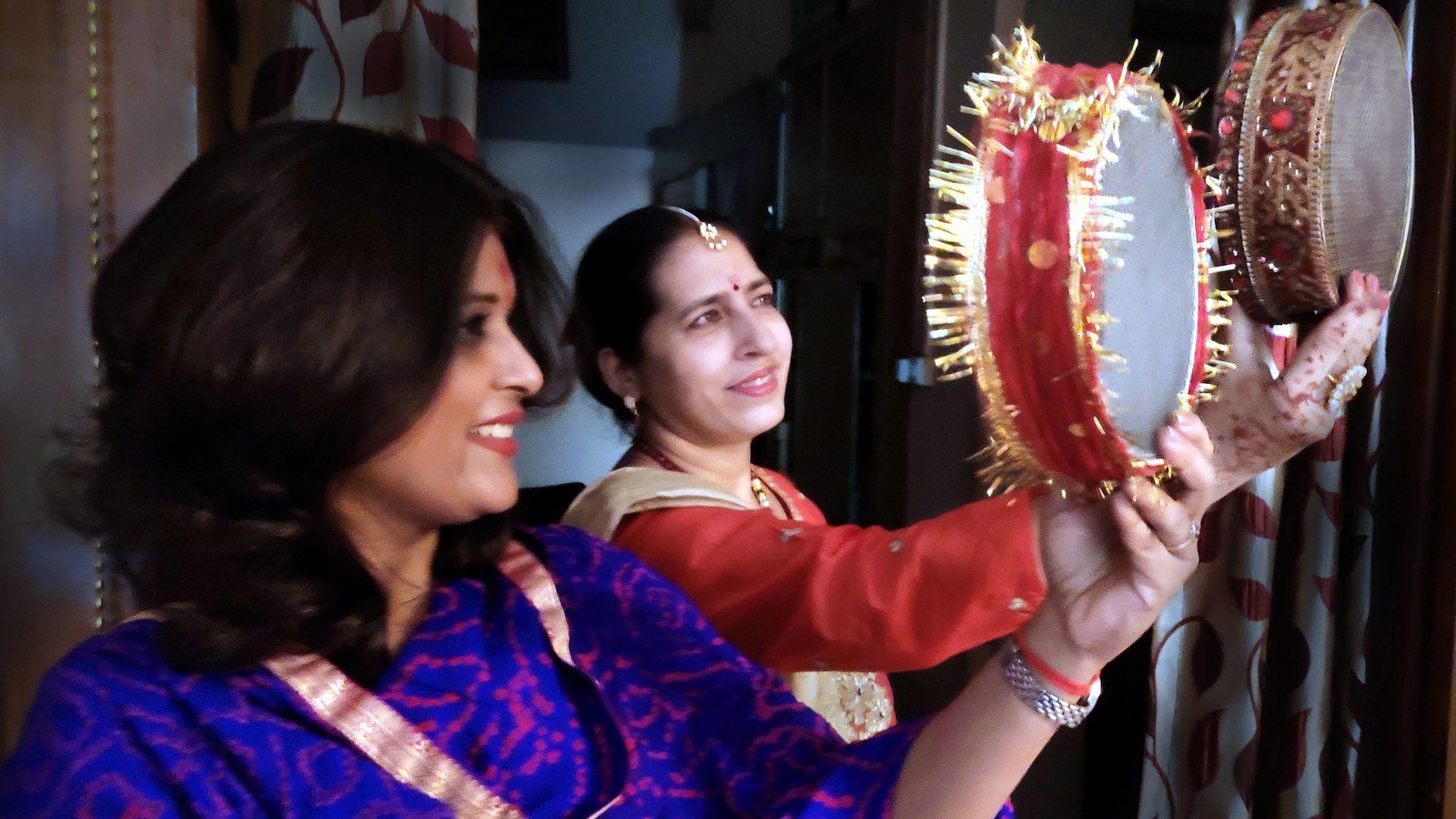
- Moonrise and arghya. Once the moon is sighted, water is offered to it from the karwa. The woman views the moon through the sieve, then views her husband through the same sieve, and prays for his long life.
- Breaking the fast. The husband gives his wife the first sip of water and the first bite of food. In many families a baya, a set of gifts for the mother-in-law, is given along with the puja.
Karwa Chauth puja samagri
A basic list that covers most traditions:
- Karwa, the earthen pot with a spout, and the chhalani or sieve
- Diya, cotton wicks, ghee or oil, and a matchbox
- Roli or kumkum, rice, incense, and a small kalash
- Water, milk, and sweets such as halwa, laddoo or peda
- Fruits, coconut, supari, cloves and cardamom
- Mathri, pheni and dry fruits for the thali
- A chunri or small cloth for the deity
- Mehendi, bindi, bangles and shringar items
- Baya, the gift set for the mother-in-law
Karwa Chauth katha: the story of Veeravati
Veeravati was the only sister of seven devoted brothers. In her first year of marriage she came home to keep the Karwa Chauth fast, and by evening she was faint with hunger and thirst. Her brothers could not bear to watch her suffer, so they lit a fire behind a tree and held up a mirror on a hill to make it look as though the moon had risen. Believing them, Veeravati broke her fast.
Soon afterwards word came that her husband was dead. Grief-stricken, she prayed to Goddess Parvati, who revealed the trick her brothers had played and told her to keep the vrata with a full heart. Veeravati kept the fast faithfully for the next year, and her husband was restored to life.
Two other stories are told on the day. One is the story of Karwa, the faithful wife who saved her husband from a crocodile and gave the festival its name. The other is the story of Savitri, who won back Satyavan from Yama with her devotion, and who is remembered in the same spirit of a wife praying for her husband.
What to eat in sargi
Sargi is meant to steady the body through a long fast without water, so it is usually light, nourishing and rich in fluids rather than heavy. Common choices are pheni with warm milk, mathri, a paratha with curd, banana and other seasonal fruit, soaked almonds and walnuts, coconut water, and a little ghee, jaggery or sugar. Many families avoid tea and very oily food in the morning because they make thirst harder to manage during the day.
Why Karwa Chauth matters
For the women who keep it, Karwa Chauth is both a prayer and a festival of marriage. The fast is a vow, the moon is its witness, and the circle of thalis is its shared part. In recent decades the vrata has travelled well beyond North India and is now kept in many Indian communities abroad as well, which is why readers outside India often ask which day applies to them. The answer is the local day of Chaturthi, and that is why the United States and Canada observe Karwa Chauth on 28 October 2026 while India observes it on 29 October.
Frequently Asked Questions
When is Karwa Chauth in 2026?
Karwa Chauth falls on Thursday, 29 October 2026. The tithi is Kartik Krishna Chaturthi, which runs from 1:06 AM to 10:09 PM on that day in Indian Standard Time.
What is the moonrise time on Karwa Chauth 2026?
On 29 October 2026 the moon rises at 8:17 PM IST in New Delhi, and the puja muhurat is from 5:38 PM to 6:56 PM. Moonrise changes from city to city: Mumbai sees the moon at 9:00 PM, Kolkata at 7:47 PM and Chennai at 8:44 PM.
Is Karwa Chauth on 28 or 29 October 2026?
In India the vrata is kept on Thursday, 29 October 2026. In the United States and Canada the Chaturthi tithi falls a day earlier, so the fast is observed there on Wednesday, 28 October 2026.
What is sargi?
Sargi is the pre-dawn meal eaten before sunrise on Karwa Chauth, usually sent by the mother-in-law. It has pheni or fenia with milk, mathri, paratha, curd, fruits, dry fruits and sweets, and it is meant to sustain the woman through a day without food or water.
Can unmarried girls keep the Karwa Chauth fast?
Yes. Traditionally the vrata is kept by married women, but in many families today unmarried girls also keep the fast, usually with the wish for a good husband.
Why is the moon seen through a sieve?
The sieve or chhalani is a filter. Viewing the moon through it and then viewing the husband through it is a way of looking past everything else at the one person the vrata is kept for. Some families instead look at the reflection of the moon in water held in the karwa.
Why is the fast broken only after moonrise?
The fast ends with chandrodaya, the rising of the moon, which is the moment of arghya. Until the moon is sighted the vrata is not complete, which is why the fast often runs past 8 PM in Indian cities on this day.
Sources and references
- Drik Panchang, Karwa Chauth date and puja timings for Delhi, 2026 (date, Chaturthi tithi, puja muhurat, moonrise, upavasa time).
- Classical vrata literature: Dharma Sindhu, Nirnayasindhu and Vratraj, where the day is listed as Karak Chaturthi. The spouted earthen karwa gives the vrata its popular name.
- City-wise moonrise for 29 October 2026 in Indian Standard Time, cross-checked against panchang tables; a one to two minute difference between panchangs is normal.
- USA and Canada date: the Chaturthi tithi falls on 28 October 2026 in those time zones, so the vrata is observed a day earlier there.
- Images: Karwa Chauth puja by CSG-Info, CC BY-SA 4.0, and moon viewing through the sieve by CSG-Info, CC BY-SA 4.0, via Wikimedia Commons.
Related reading
What is Fasting? Spiritual benefits of fasting
Pradosh Vrat Katha, dates, puja vidhi and mantras
16 Somwar Vrat Katha: fasting guide and puja vidhi
What happens at a Hindu wedding ceremony?
Chandra Deva, the Moon god who governs the mind